
Food Dehydrators: How They Work and Which One to Buy
A food dehydrator dries food with warm air from a heater and a fan, usually between about 95 and 165 °F. Horizontal models blow air across every tray and dry evenly; vertical stacked models are smaller but need tray rotation. Choose by drying area, airflow, temperature range, timer and tray material.
A food dehydrator is a heater, a fan and a set of trays in one box. Warm air flows over thin slices of food and carries their moisture away, so fruit, vegetables, herbs and jerky keep much longer. This page explains the types and compares six models we cover in depth.
How does a food dehydrator work?
It heats air, usually to somewhere between 95 and 165 °F (35-74 °C), and a fan moves it across the food. The warm air absorbs water from the surface, and the fan carries it out through vents. Drying continues until the food is leathery, crisp or brittle, depending on what it is.
A dehydrator removes most of the water, not all of it. Texture changes, and dried food still needs airtight storage. It is also a different machine from a freeze dryer: our freeze dryer vs dehydrator comparison explains the trade-offs.
What types of dehydrator are there?
There are two main designs: horizontal (rear fan, box shape) and vertical (bottom or top fan, stacked trays).
| Type | How air moves | Strengths | Weaknesses | Example |
|---|---|---|---|---|
| Horizontal | A rear fan blows across every shelf | Even drying, less tray rotation, large square trays | Bigger and heavier | Cosori P101, Excalibur Performance 10-Tray |
| Vertical | A fan in the base or lid pushes air through a stack | Compact, light, often expandable | Trays nearest the fan dry faster | Hamilton Beach 32100A, NESCO FD-75A |
Horizontal models usually come in a box with a door, and many use stainless steel trays. Vertical stacked models are often round and plastic; the NESCO FD-75A expands from 5 to 12 trays, according to its listing.
What can I dry in a food dehydrator?
Fruit, vegetables, herbs, jerky and homemade pet treats are the classic uses. Each group needs a different temperature, so a wide range is worth having:
| Food | Typical setting (orientative) | What you want at the end |
|---|---|---|
| Herbs | 95-104 °F (35-40 °C) | Leaves that crumble |
| Vegetables | 122-131 °F (50-55 °C) | Crisp or brittle pieces |
| Fruit | 131-140 °F (55-60 °C) | Leathery and pliable, no moist spots |
| Jerky | Meat heated to 160 °F first, then dried at 130-140 °F (54-60 °C), per the USDA | Bends and cracks without breaking |
Times depend on thickness, moisture and how full the trays are. Our drying times and temperatures guide gives ranges for each group.
How do I choose a dehydrator in 5 points?
Check drying area, airflow, temperature range, timer and tray material, in that order.
- Drying area. It tells you more than tray count. The 10-tray Cosori P101 offers 16.2 ft² and the 10-tray LEM BigBite 10.0 ft².
- Airflow. Horizontal for even drying; vertical if space and weight matter more.
- Temperature range. At least 160 °F (71 °C) at the top for jerky, and around 95 °F (35 °C) or lower at the bottom for herbs.
- Timer. At least 24 hours for overnight batches. The Excalibur Performance goes to 80 hours.
- Tray material. Stainless steel or BPA-free plastic. Some “steel” trays are chrome-plated, like the Excalibur Select’s.
The full walkthrough is in how to choose a food dehydrator.
How do the main models compare?
These six cover the range from a 5-tray stacked unit to 10-tray cabinets. Every figure comes from the Amazon listing; an empty cell means the manufacturer does not publish it there.
| Model | Trays | Drying area (cm²) | Min temp (°C) | Max temp (°C) | Timer (h) | Airflow | DryFoodLab score | Best for | |
|---|---|---|---|---|---|---|---|---|---|
| 10 | 15,050 | 35 | 74 | 48 | Horizontal | 9.5 | Most homes | ||
| 10 | 14,864 | 29 | 74 | 80 | Horizontal | 9.5 | Long runs | ||
| 10 | 9,290 | 35 | 80 | 24 | Horizontal | 9.5 | Longest warranty | ||
| 6 | 8,918 | 29 | 74 | 60 | Horizontal | 9 | Compact cabinet | ||
| 5 | — | 35 | 71 | — | Vertical | 6 | Expandable stack | ||
| 5 | 3,902 | 38 | 71 | 48 | Vertical | 7 | Budget digital |
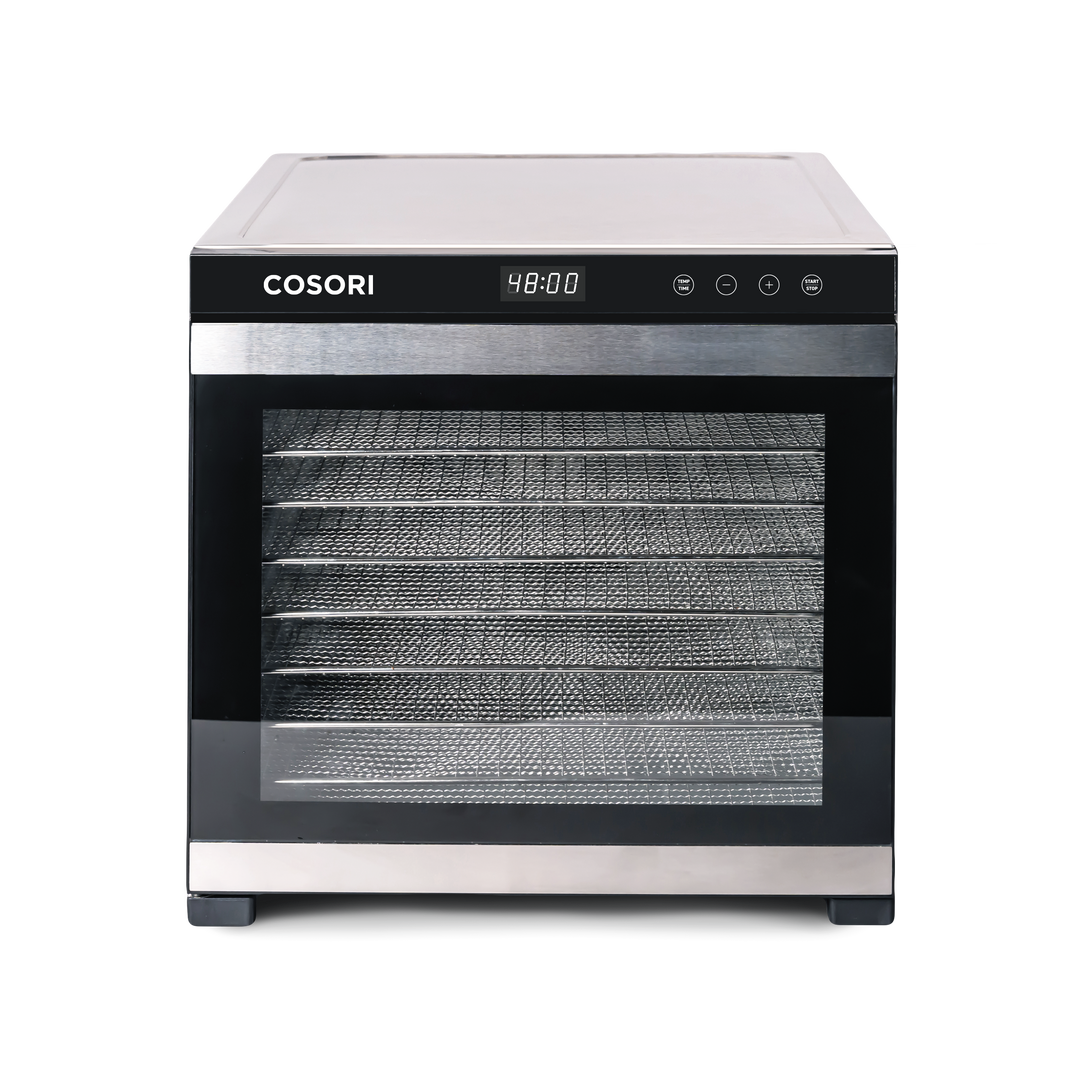
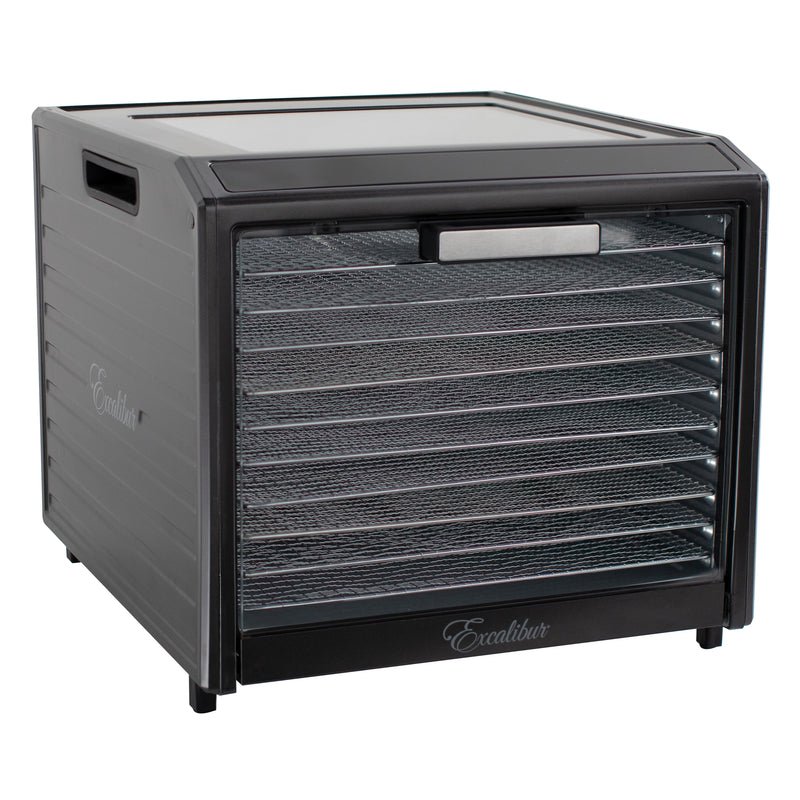

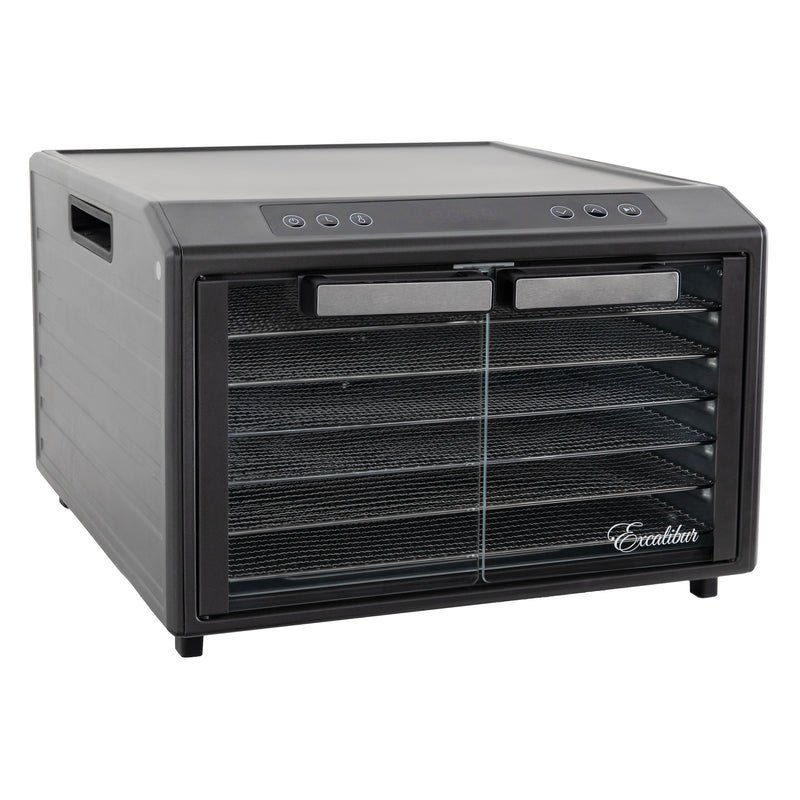


(affiliate link) · Data from the Amazon listing; offers may change.
Two details stand out. The NESCO FD-75A does not declare a timer, so you have to switch it off yourself. The Hamilton Beach 32100A has 4.2 ft² on five BPA-free trays with a 48-hour digital timer, but its vertical airflow means some tray swapping on full loads.
Where should I go next?
Pick the page that matches what you need:
- Rankings: the 8 best food dehydrators, stainless steel models, horizontal airflow models, large dehydrators with 8+ trays and small dehydrators.
- By use: best for jerky, best for fruit, best for dog treats and best for herbs.
- Reviews: Cosori P101, Excalibur Performance 10-Tray, Excalibur Select 6-Tray, NESCO FD-16DZD and LEM BigBite 10-Tray.
- Head-to-heads: Cosori P101 vs Excalibur Performance, Excalibur Select vs Cosori CP267-FD and NESCO FD-75A vs Hamilton Beach 32100A.
- Guides: drying times and temperatures, how to make jerky safely and how to dehydrate fruit.
- Problems: uneven drying and sticky dried fruit.
Want to know what a batch costs in electricity? Try the drying cost calculator. To keep dried food for months, see long-term food storage.
All about food dehydrators
Rankings and picks
- The 8 Best Food Dehydrators of 2026The 8 best food dehydrators of 2026 compared on trays, drying area, temperature and airflow, from a 5-tray compact to a 16-tray dual-zone model.
- The 5 Best Food Dehydrators for Dog Treats in 2026The 5 best food dehydrators for homemade dog treats, compared on trays, heat range and cleaning, with USDA meat safety and no-seasoning rules.
- The 6 Best Food Dehydrators for Fruit in 2026The 6 best food dehydrators for fruit and fruit leather, compared on drying area, airflow, timer and included sheets, plus prep, drying and conditioning tips.
- The 5 Best Food Dehydrators for Herbs in 2026The 5 best food dehydrators for drying herbs, chosen for low minimum temperatures from 86 °F, compared on trays, mesh screens and airflow, with drying tips.
- The 6 Best Food Dehydrators for Jerky in 2026The 6 best food dehydrators for jerky, all reaching at least 160 °F, compared on trays, heat range and timer, with USDA safety steps for beef and poultry.
- The 6 Best Horizontal Airflow Food Dehydrators of 2026Six rear-fan food dehydrators with horizontal airflow, compared on trays, drying area, temperature and timer, plus why side airflow dries more evenly.
- The 6 Best Large Food Dehydrators (8+ Trays) of 2026Six large food dehydrators with 8 to 16 trays compared on drying area, power, heat range and weight, for garden harvests, hunting season and bulk jerky.
- The 6 Best Small Food Dehydrators of 2026Six small food dehydrators with 5 or 6 trays compared on drying area, weight, heat range and timer, from a 2.2 kg stack to a 9.6 ft² compact cabinet.
- The 6 Best Stainless Steel Food Dehydrators of 2026Six food dehydrators with stainless steel trays, from a 5-tray compact to 16.2 ft² models, compared on drying area, heat range, timer and warranty.
Reviews
- Cosori P101 Review: 10 Steel Trays, 16.2 ft² and 165 °FCosori P101 review from the official listing: 10 stainless steel trays, 16.2 ft² of drying area, 1,000 W, 95-165 °F, 48-hour timer and its trade-offs.
- Excalibur Performance 10-Tray Review: 80-Hour Timer, 16 ft²Excalibur Performance Series 10-Tray review from the listing: 16 ft² on stainless trays, 800 W, 85-165 °F, an 80-hour timer and a 3-year warranty.
- Excalibur Select 6-Tray Review: 9.6 ft² in a Compact BoxExcalibur Select Series 6-Tray review from the listing: 9.6 ft² on chrome-plated trays, 700 W, 85-165 °F, a 60-hour timer and a 3-year warranty.
- LEM BigBite 10-Tray Review: A Jerky-First Stainless DehydratorLEM BigBite 10-Tray review from the official listing: 10 ft² on dishwasher-safe stainless trays, 800 W, 95-176 °F, 24-hour timer and a 5-year warranty.
- NESCO FD-16DZD Review: 16 Trays and Two Independent ZonesNESCO FD-16DZD review from the listing: 16 stainless steel trays, two zones with separate controls, 1,200 W, 95-160 °F and a 24-hour timer, plus gaps.
Comparisons
- Cosori P101 vs Excalibur Performance 10-Tray: Which to Buy?Cosori P101 vs Excalibur Performance 10-Tray on official specs: drying area, power, temperature range, timer, weight and warranty, with a clear pick.
- Excalibur Select 6-Tray vs Cosori CP267-FD: Six-Tray ShowdownExcalibur Select 6-Tray vs Cosori CP267-FD on official specs: drying area, tray material, noise, cleaning, timer and warranty, plus which to buy.
- NESCO FD-75A vs Hamilton Beach 32100A: Entry-Level ShowdownNESCO FD-75A Snackmaster Pro vs Hamilton Beach 32100A on official specs: power, timer, trays, expansion, cleaning and airflow, plus which one to pick.
Guides and calculators
- Food Dehydrator Drying Times and Temperatures Chart (°F and °C)Food dehydrator drying times and temperatures in °F and °C for fruit, vegetables, herbs and jerky, plus how to tell when food is dry. Guideline ranges.
- How to Choose a Food Dehydrator: 8 Specs That Actually MatterHow to choose a food dehydrator: drying area, airflow, jerky-safe temperatures, timer, stainless vs plastic trays, noise and cleaning, with examples.
- How to Dehydrate Fruit: Prep, Lemon Dip, Drying and ConditioningHow to dehydrate fruit in a food dehydrator: prep, lemon juice pretreatment, slice thickness, 131-140 °F guideline, dryness tests and conditioning in jars.
- How to Make Jerky in a Dehydrator: The USDA-Safe MethodHow to make jerky in a food dehydrator following USDA guidance: heat meat to 160 °F first, dry at 130-140 °F, plus slicing, marinating and storage.
Troubleshooting and care
- Why Is My Dehydrated Fruit Sticky? Causes and FixesDehydrated fruit still sticky? Learn whether it is natural sugar or leftover moisture, and fix it with more time, lower heat, thinner slices and conditioning.
- Dehydrator Drying Unevenly? Causes and FixesFood dehydrator drying unevenly? Find out why trays near the fan finish first and fix it with rotation, even slicing, lighter loads and better airflow.
Frequently asked questions
What does a food dehydrator do?
It removes most of the water from food with warm, moving air, which slows spoilage. Fruit, vegetables, herbs and jerky keep for longer, but texture changes and some water always remains.
Is a dehydrator the same as a freeze dryer?
No. A dehydrator uses heat and a fan. A freeze dryer freezes food and removes the ice under vacuum, which keeps shape and color better, but the machine weighs tens of kilograms and a home cycle typically takes 20-40 hours.
Can I make jerky in any food dehydrator?
Only in one that holds the USDA drying range of 130-140 °F, and only after heating the meat to 160 °F (poultry 165 °F). All six models on this page reach at least 160 °F.
How many trays do I need?
Look at drying area rather than tray count. About 3 ft² suits occasional snacks for one or two people; 10-16 ft² suits family batches, garden harvests and bulk jerky.
Do I need to rotate dehydrator trays?
With vertical, stacked models, usually yes, because trays nearest the fan dry faster. Horizontal rear-fan models need less rotation, though swapping front and back can still help with full loads.