
Vacuum Sealers: How They Work and Which One to Buy
A vacuum sealer pulls air out of a bag and closes it with a heated strip, which slows oxidation and freezer burn. Most home models are bar (external) sealers that need embossed bags; chamber sealers handle liquids. Choose by suction in kPa, double seal, moist mode, accessory port and warranty.
A vacuum sealer is a small pump and a heated sealing strip in one machine. It pulls air out of a bag, then melts the bag shut, so food meets less oxygen in the fridge, freezer or pantry. This page explains the types, the specs worth checking and six models we cover in depth.
How does a vacuum sealer work?
It sucks the air out of the bag through the open end, then a hot wire or strip melts the two layers together. On a bar sealer, you place the bag mouth in a channel, close the lid and the pump draws air until it reaches its limit. Then the heating element seals the bag.
Less air means slower oxidation and much less freezer burn. It does not sterilize food. Vacuum sealing does not replace refrigeration: perishable food still needs the fridge or freezer, because Clostridium botulinum can grow in moist, low-acid food without oxygen. Our guide to vacuum sealing food covers what is safe and what is not.
What types of vacuum sealer are there?
There are three: bar (external) sealers, chamber sealers and handheld sealers. Nearly every home model on Amazon is a bar sealer.
| Type | How it works | Strengths | Weaknesses |
|---|---|---|---|
| Bar (external) | The bag mouth sits in a channel outside the machine | Compact, light, affordable range | Needs embossed bags; liquids get sucked toward the pump |
| Chamber | The whole bag goes inside a sealed box | Handles liquids and smooth bags | Larger and much heavier |
| Handheld | A small pump draws air through a valve on reusable bags | Tiny and portable | Needs special valve bags; no heat seal |
All 12 sealers in our US catalog are bar or handheld models; it does not include a chamber sealer yet. If you seal soups often, read our sealers for liquids page for workarounds.
How do I choose a vacuum sealer in 5 points?
Check suction, sealing, moisture handling, accessory port and warranty, in that order.
- Suction (kPa). Higher kPa pulls a tighter vacuum. Several models declare 95 kPa; FoodSaver does not publish a figure. See sealers with 90 kPa and up.
- Double seal. Two heating strips give a backup seal line, useful for freezer and sous vide bags. See double seal vacuum sealers.
- Moist mode. It changes the vacuum and seal time for wet food. The FoodSaver V4440 detects moisture automatically.
- Accessory port. A hose port lets you vacuum jars and canisters. See sealers for mason jars.
- Warranty. It ranges from 1 year (Nesco VS-12) to 5 years (Beelicious VS9313, Gasbye, both FoodSavers) in our catalog.
Built-in roll storage and a cutter save time if you make custom-size bags. The full walkthrough is in how to choose a vacuum sealer.
How do the main models compare?
These six cover compact, bar and 2-in-1 sealers. Figures come from the product listing and, for the V4440, the FoodSaver specification. A blank cell means we do not have a reliable figure for it.
| Model | Vacuum (kPa) | Power (W) | Double seal | Moist mode | Accessory port | Weight (kg) | Warranty (years) | DryFoodLab score | Best for | |
|---|---|---|---|---|---|---|---|---|---|---|
| 95 | 130 | Yes | Yes | Yes | 2.4 | 5 | 9.5 | Most homes | ||
| 95 | 130 | Yes | — | Yes | 2.9 | 5 | 9 | Sous vide | ||
| — | 120 | Yes | — | Yes | 3 | 5 | 8 | Known brand, double seal | ||
| — | 128 | — | Yes | Yes | — | 5 | 8 | Auto moisture, 2-in-1 | ||
| — | 130 | Yes | Yes | — | 2.7 | 1 | 7 | Gentle vacuum | ||
| 80 | 110 | — | Yes | Yes | 1.2 | — | 7 | Lightest |


(affiliate link) · Data from the Amazon listing; offers may change.
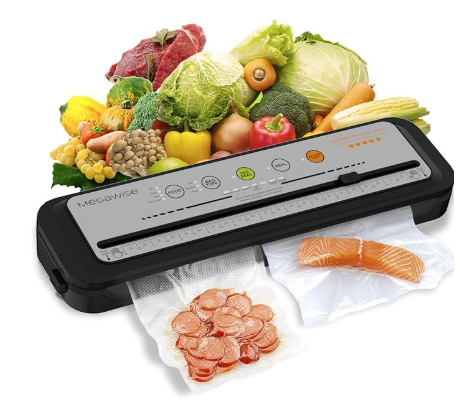
Two details stand out. The FoodSaver models are the best-known names here, but neither listing publishes a suction figure in kPa. The MEGAWISE VS6621 is the lightest at 1.2 kg (about 2.6 lb), but its listing gives no warranty and no double seal.
Where should I go next?
Pick the page that matches what you need:
- Rankings: the 8 best vacuum sealers, sealers with 90 kPa and up and double seal vacuum sealers.
- By use: best for mason jars, best for liquids and best for sous vide.
- Reviews: FoodSaver FM2100, FoodSaver V4440, Beelicious Pro VS9313 and Gasbye VS5166.
- Head-to-heads: FoodSaver FM2100 vs V4440 and Beelicious Pro VS9313 vs Gasbye VS5166.
- Guides: how to choose a vacuum sealer and how to vacuum seal food.
- Problems: sealer not vacuuming and sealer not sealing.
- Brands: FoodSaver and Nesco.
For shelf-stable storage of dry food, a vacuum bag is not the end of the story. Mylar bags with oxygen absorbers block light as well as air; see long-term food storage.
All about vacuum sealers
Rankings and picks
- The 6 Best Vacuum Sealers With 90 kPa and Up in 2026Six vacuum sealers declaring 95-98 kPa of suction, compared on double seal, moist mode, accessory port and warranty, with what kPa really means.
- The 8 Best Vacuum Sealers of 2026The 8 best vacuum sealers of 2026 compared on suction, double seal, moist mode, accessory port and warranty, from FoodSaver to 95 kPa dual-pump models.
- The 6 Best Double Seal Vacuum Sealers of 2026Six vacuum sealers with dual heat sealing strips, from FoodSaver and Nesco to 95 kPa models, compared on suction, moist mode, port and warranty.
- The 6 Best Vacuum Sealers for Liquids and Wet Food in 2026The 6 best vacuum sealers for liquids, soups and marinades, all with a moist mode, compared on suction and sensors, plus how to seal wet food without a mess.
- The 6 Best Vacuum Sealers for Mason Jars in 2026The 6 best vacuum sealers for mason jars, all with an accessory port, compared on suction, hose, modes and warranty, plus how to vacuum seal a jar safely.
- The 5 Best Vacuum Sealers for Sous Vide in 2026The 5 best vacuum sealers for sous vide, compared on suction, double seal, moist mode and warranty, plus how to seal bags that sink and stay sealed.
Reviews
- Beelicious Pro VS9313 Review: 95 kPa, Double Seal and a 5-Year WarrantyBeelicious Pro VS9313 review from the official listing: 95 kPa dual pump, double seal, Dry, Moist, Pulse and Canister modes, app, 5-year warranty and gaps.
- FoodSaver FM2100 Review: Double Seal, Accessory Port, 5-Year WarrantyFoodSaver FM2100 review from the official listing: dual heat strips, accessory port, roll storage, 120 W, 5-year warranty, and the specs FoodSaver leaves out.
- FoodSaver V4440 Review: 2-in-1 Sealer With Automatic Moisture DetectionFoodSaver V4440 review: handheld sealer, automatic moisture detection, jar accessories, 128 W and a 5-year warranty.
- Gasbye VS5166 Review: 95 kPa and a Double Seal Built for Sous VideGasbye VS5166 review from the official listing: 95 kPa, double heat seal, easy-lock handle, bag storage, suction hose and 5-year coverage, plus its moist gap.
Comparisons
- Beelicious Pro VS9313 vs Gasbye VS5166: Which 95 kPa Sealer to Buy?Beelicious Pro VS9313 vs Gasbye VS5166 on official specs: 95 kPa, double seal, moist mode, Pulse, weight and 5-year warranty, with a clear pick for each use.
- FoodSaver FM2100 vs V4440: Which FoodSaver Should You Buy?FoodSaver FM2100 vs V4440 on official specs: double seal vs auto moisture detection, handheld sealer, jar accessories, power, weight and warranty.
Guides and calculators
- How to Choose a Vacuum Sealer: 8 Specs That Actually MatterHow to choose a vacuum sealer: bar vs chamber vs handheld, kPa, double seal, moist mode, embossed bags, rolls, accessory port and warranty, with real examples.
- How to Vacuum Seal Food: Step by Step, Liquids and SafetyHow to vacuum seal food step by step: bag prep, sealing liquids, foods that need extra care, botulism risk and what vacuum sealing does to storage life.
Troubleshooting and care
- Vacuum Sealer Not Sealing Properly? Causes and FixesVacuum sealer bags losing air or seals peeling open? Fix moisture on the seal area, a dirty or worn heating strip, the wrong seal time and unsuitable bags.
- Vacuum Sealer Not Vacuuming? Causes and FixesVacuum sealer not pulling air out of the bag? Check for smooth bags, a worn gasket, wrinkles, liquid in the pump path or a dirty drip area, and fix it fast.
Frequently asked questions
What does a vacuum sealer do?
It removes most of the air from a bag and seals it with heat. Less oxygen slows oxidation and freezer burn, so food keeps its quality longer in the fridge, freezer or pantry.
Does vacuum sealing replace the fridge?
No. Perishable food still needs the fridge or freezer after sealing. Without oxygen, Clostridium botulinum can grow in moist, low-acid food kept at room temperature.
Do I need special bags for a vacuum sealer?
For bar (external) sealers, yes: bags or rolls must be embossed or textured so air can escape. Chamber sealers also work with smooth bags.
What is a good suction figure for a vacuum sealer?
Several bar sealers in our US catalog declare 95 kPa, and one declares 98 kPa. The MEGAWISE VS6621 declares 80 kPa. FoodSaver and Nesco do not publish a kPa figure on their listings.
Can a vacuum sealer seal liquids?
A bar sealer can pull liquid into the machine. Use a moist mode, pulse the vacuum by hand or freeze liquids first. Chamber sealers handle liquids best, but none is in our US catalog yet.