
The 6 Best Mylar Bags and Oxygen Absorbers of 2026
- Data from official spec sheets
- Public scoring formula
- No paid placements
The SYMYNELEC 100-bag kit is the best mylar kit for most homes: three food-grade sizes, 11.8 mil gallon bags, zip tops, labels and 400 cc absorbers. The Home Sensei kit has thicker 14.8 mil gallon bags, and the Leboduo kit pairs 120 bags with 120 absorbers. Add the ZRLEI 400 cc pack to refill any kit.
On this page (9)
- How do the 6 products compare?
- Are the absorbers in each kit big enough?
- What else do you need besides bags and absorbers?
- Which one fits your pantry?
- The 6 best mylar bags and oxygen absorbers, reviewed
- How do I choose mylar bags and absorbers?
- What are the most common buying mistakes?
- Which one should I pick by cost level?
- What is our verdict?
The SYMYNELEC 100-bag kit is the best mylar kit for most homes. Its listing declares three sizes (35 gallon, 45 quart and 20 half-pint bags), food-grade material, 11.8 mil gallon bags, zip tops, labels and 400 cc absorbers. The Home Sensei kit has thicker gallon bags at 14.8 mil. The Leboduo kit matches 120 bags with 120 absorbers.
We compared the storage products in our US catalog using only the specs on each Amazon listing. We have not packed food in them ourselves. When a listing leaves out a figure or contradicts itself, we say so.
SYMYNELEC 100 Mylar bags + 55 × 400cc absorbers kit
100 bags · 11.8 mil · 55 × 400 cc
100 food-grade bags in three sizes, 11.8 mil gallon bags, zip tops, labels and 400 cc absorbers.
The catch: Only 55 absorbers for 100 bags, so you will need refills.
Home Sensei Mylar bags 1 gallon + 400cc absorbers (30)
30 bags · 14.8 mil · 30 × 400 cc
30 gallon bags at 14.8 mil with 30 × 400 cc absorbers packed in sets of 5.
The catch: One size only, and the listing quotes 14, 14.8 and 15 mil in different places.
Leboduo 120 Mylar bags + 120 × 300cc absorbers
120 bags · 8 mil · 120 × 300 cc
120 bags in four sizes with 120 × 300 cc absorbers and 125 labels.
The catch: 8 mil at most, the thinnest kit here, and 300 cc is tight for gallon bags of light food.
How do the 6 products compare?
Five are bag-and-absorber kits and one is a refill pack of absorbers; they differ in thickness, sizes and absorber capacity. Thickness is the maximum the listing declares; smaller bags in the same kit are often thinner. Empty cells mean the listing does not publish that figure.
| Model | Bags | Sizes | Thickness (mil) | Absorbers | Absorber (cc) | Food grade | Labels | DryFoodLab score | Best for | |
|---|---|---|---|---|---|---|---|---|---|---|
| 100 | 26×35, 18×26, 11×16 cm | 11.8 | 55 | 400 | Yes | Yes | 9 | Most homes | ||
| 30 | 25×36 cm | 14.8 | 30 | 400 | Yes | Yes | 9 | Thick gallon bags | ||
| 120 | 25×36, 19×29, 15×23, 11×16 cm | 8 | 120 | 300 | Yes | Yes | 9 | One absorber per bag | ||
| 100 | 25×36, 15×23, 11×16 cm | 9 | 100 | 300 | Yes | Yes | 9 | Small portions | ||
| 120 | 26×36, 21×31, 18×26, 14×19 cm | 10.5 | 150 | 500 | — | Yes | 8.5 | Most absorber capacity | ||
| — | — | — | 100 | 400 | Yes | — | 6 | Refills |
(affiliate link) · Data from the Amazon listing; offers may change.
Here is how bags and absorbers line up in each kit:
| Product | Bags | Absorbers | Absorbers per bag | Max thickness |
|---|---|---|---|---|
| SYMYNELEC 100 kit | 100 | 55 × 400 cc | 0.55 | 11.8 mil |
| Home Sensei 1 gallon | 30 | 30 × 400 cc | 1 | 14.8 mil |
| Leboduo 120 kit | 120 | 120 × 300 cc | 1 | 8 mil |
| Sukerle 100 kit | 100 | 100 × 300 cc | 1 | 9 mil |
| ROYLO GLOBE 120 kit | 120 | 100 × 400 cc + 50 × 500 cc | 1.25 | 10.5 mil |
| ZRLEI absorbers | – | 100 × 400 cc | – | – |
Are the absorbers in each kit big enough?
For quart and smaller bags, yes; for gallon bags of light food, usually not. The math below uses a 1-gallon bag (3.8 liters) and the 21% rule: liters of air × 0.21 = ml of oxygen. The share of air depends on how tightly the food packs.
| Food in a 1-gallon bag | Air left (approx.) | Oxygen to remove | 300 cc absorbers | 400 cc absorbers | 500 cc absorbers |
|---|---|---|---|---|---|
| Rice, sugar, flour (35% air) | 1.33 L | about 279 ml | 1 (little margin) | 1 | 1 |
| Pasta, beans, oats (60% air) | 2.28 L | about 479 ml | 2 | 2 | 1 (little margin) |
| Freeze-dried food, fruit chips (80% air) | 3.04 L | about 638 ml | 3 | 2 | 2 |
In practice, that means the one-per-bag kits (Leboduo, Sukerle, Home Sensei) cover dense staples in gallon bags and almost anything in quart bags. For pasta, beans or freeze-dried food in gallon bags, plan on a second absorber. The ROYLO GLOBE kit, with 150 absorbers including 50 of 500 cc, has the most room to double up.
What else do you need besides bags and absorbers?
A way to heat seal, a marker and, ideally, a food-grade bucket. None of these kits includes a sealer.
- Heat sealer or clothes iron. Mylar needs heat to seal. The ROYLO GLOBE listing recommends a professional-grade heat sealer; a clothes iron on a flat board also works for many home users.
- An airtight jar for spare absorbers. Once a pack is open, the rest must go back into a sealed jar or bag straight away.
- A bucket. Mylar is thin enough for rodents and sharp corners to pierce. A lidded food-grade bucket adds a hard outer layer.
- Dry food. If you dry your own, finish it fully first; our freeze-drying guide and fruit dehydrating guide explain how to check.
Which one fits your pantry?
Match the kit to the food you store and how often you open it. Tap a card to jump to the full entry.
Pick by what you need
- A first long-term pantry with mixed bag sizesSYMYNELEC 100 kit
- Bulk rice, beans and pasta in gallon bagsHome Sensei 1 gallon
- Many small portions, each with its absorberLeboduo 120 kit
- Spices, coffee, candy and snacksSukerle 100 kit
- Light, airy foods that need more absorberROYLO GLOBE 120 kit
- Refilling any kit or bigger bagsZRLEI 400 cc
The 6 best mylar bags and oxygen absorbers, reviewed
1. SYMYNELEC 100 Mylar bags + 55 × 400cc absorbers kit
100 bags · 11.8 mil · 55 × 400 cc
9/10 · DryFoodLab scoreThe SYMYNELEC kit covers the most common jobs in one box. The listing declares 35 gallon bags (10.2 × 13.8 in), 45 quart bags (7.1 × 10.2 in) and 20 half-pint bags (4.3 × 6.3 in). Thickness is 11.8 mil for gallon bags, 9.4 for quarts and 9 for half pints.
It states food-grade material, a resealable zipper and 100 labels. The 55 absorbers are 400 cc and individually sealed, which limits waste when you open them. The catch is the count: 55 absorbers do not cover 100 bags. Plan on a refill pack. Our SYMYNELEC review runs the numbers bag by bag.
Pros
- 35 gallon, 45 quart and 20 half-pint bags in one box
- Food-grade claim, zip tops and labels
- 400 cc absorbers, individually sealed
Cons
- 55 absorbers for 100 bags
- Small inconsistencies in the listing on label count and bag sizes
- Best for
- A first long-term pantry with staples and portions
- Skip it if
- Filling all 100 bags at once without extra absorbers
Specifications
| Type | Bags + absorbers |
|---|---|
| Bags | 100 |
| Absorbers | 55 |
| Absorber (cc) | 400 |
| Thickness (mil) | 11.8 |
| Sizes | 26×35, 18×26, 11×16 cm |
| Zip seal | Yes |
| Food grade | Yes |
| Labels | Yes |
2. Home Sensei Mylar bags 1 gallon + 400cc absorbers (30)
30 bags · 14.8 mil · 30 × 400 cc
9/10 · DryFoodLab scoreThe Home Sensei kit is 30 gallon bags, 30 absorbers of 400 cc and 30 stickers. The listing measures the bags at 10 × 14 in with a 4.3 in gusset, so they stand up when filled.
At 14.8 mil, these are the thickest bags among the kits. That helps with pointy foods like pasta and with handling. The absorbers come in six packs of five, so you only expose five at a time. The drawbacks are one size only and an inconsistent listing: the title says 15 mil, one bullet 14.8 and another 14 mil.
Pros
- 14.8 mil gallon bags, the thickest kit here
- 30 × 400 cc absorbers packed 5 at a time
- Food grade, zip top and 30 stickers
Cons
- Only one size: 1 gallon
- Listing quotes 14, 14.8 and 15 mil in different places
- Best for
- Bulk staples such as rice, beans and pasta
- Skip it if
- Small portions you open often
Specifications
| Type | Bags + absorbers |
|---|---|
| Bags | 30 |
| Absorbers | 30 |
| Absorber (cc) | 400 |
| Thickness (mil) | 14.8 |
| Sizes | 25×36 cm |
| Zip seal | Yes |
| Food grade | Yes |
| Labels | Yes |
3. Leboduo 120 Mylar bags + 120 × 300cc absorbers
120 bags · 8 mil · 120 × 300 cc
9/10 · DryFoodLab scoreThe Leboduo kit is the one to pick if you want the bag count and absorber count to match. The listing declares 20 gallon, 25 two-quart, 35 quart and 40 half-pint bags, with 120 absorbers of 300 cc and 125 labels.
A 300 cc absorber is plenty for quart and smaller bags. In a gallon bag of dense rice, it is close to the 279 ml of oxygen the 21% rule predicts, so it has little margin. The bags top out at 8 mil, the thinnest of the kits. Leboduo mentions a 180-day warranty, which is unusual for bags.
Pros
- 120 bags in four sizes, from gallon to half pint
- 120 × 300 cc absorbers, one per bag
- Food grade, zip tops and 125 labels
Cons
- 8 mil maximum, the thinnest kit here
- 300 cc is tight for gallon bags of light food
- Best for
- Many small and medium portions
- Skip it if
- Gallon bags of pasta or freeze-dried food without extra absorbers
Specifications
| Type | Bags + absorbers |
|---|---|
| Bags | 120 |
| Absorbers | 120 |
| Absorber (cc) | 300 |
| Thickness (mil) | 8 |
| Sizes | 25×36, 19×29, 15×23, 11×16 cm |
| Zip seal | Yes |
| Food grade | Yes |
| Labels | Yes |
4. Sukerle 100 Mylar bags + 100 × 300cc absorbers
100 bags · 9 mil · 100 × 300 cc
9/10 · DryFoodLab scoreThe Sukerle kit leans small. The listing declares 25 gallon bags (10 × 14 in), 35 bags of 6 × 9 in and 40 of 4.3 × 6.3 in, all at 9 mil. It includes 100 absorbers of 300 cc, 150 labels and 10 clips.
It names candy, coffee, spices and freeze-dried products among its uses, which fits the small sizes. The listing also gives a temperature range of −50 to 120 °C (−58 to 248 °F). For bulk staples, 25 gallon bags run out fast.
Pros
- 100 × 300 cc absorbers, one per bag
- Food grade, zip tops, 150 labels and 10 clips
- Rated from −58 °F to 248 °F (−50 to 120 °C)
Cons
- Only 25 gallon bags; most are 6 × 9 in or smaller
- 9 mil maximum
- Best for
- Spices, coffee, tea, candy and portioned snacks
- Skip it if
- Bulk staples in large bags
Specifications
| Type | Bags + absorbers |
|---|---|
| Bags | 100 |
| Absorbers | 100 |
| Absorber (cc) | 300 |
| Thickness (mil) | 9 |
| Sizes | 25×36, 15×23, 11×16 cm |
| Zip seal | Yes |
| Food grade | Yes |
| Labels | Yes |
5. ROYLO GLOBE 120 Mylar bags + 150 absorbers kit
120 bags · 8.5–10.5 mil · 100 × 400 cc + 50 × 500 cc
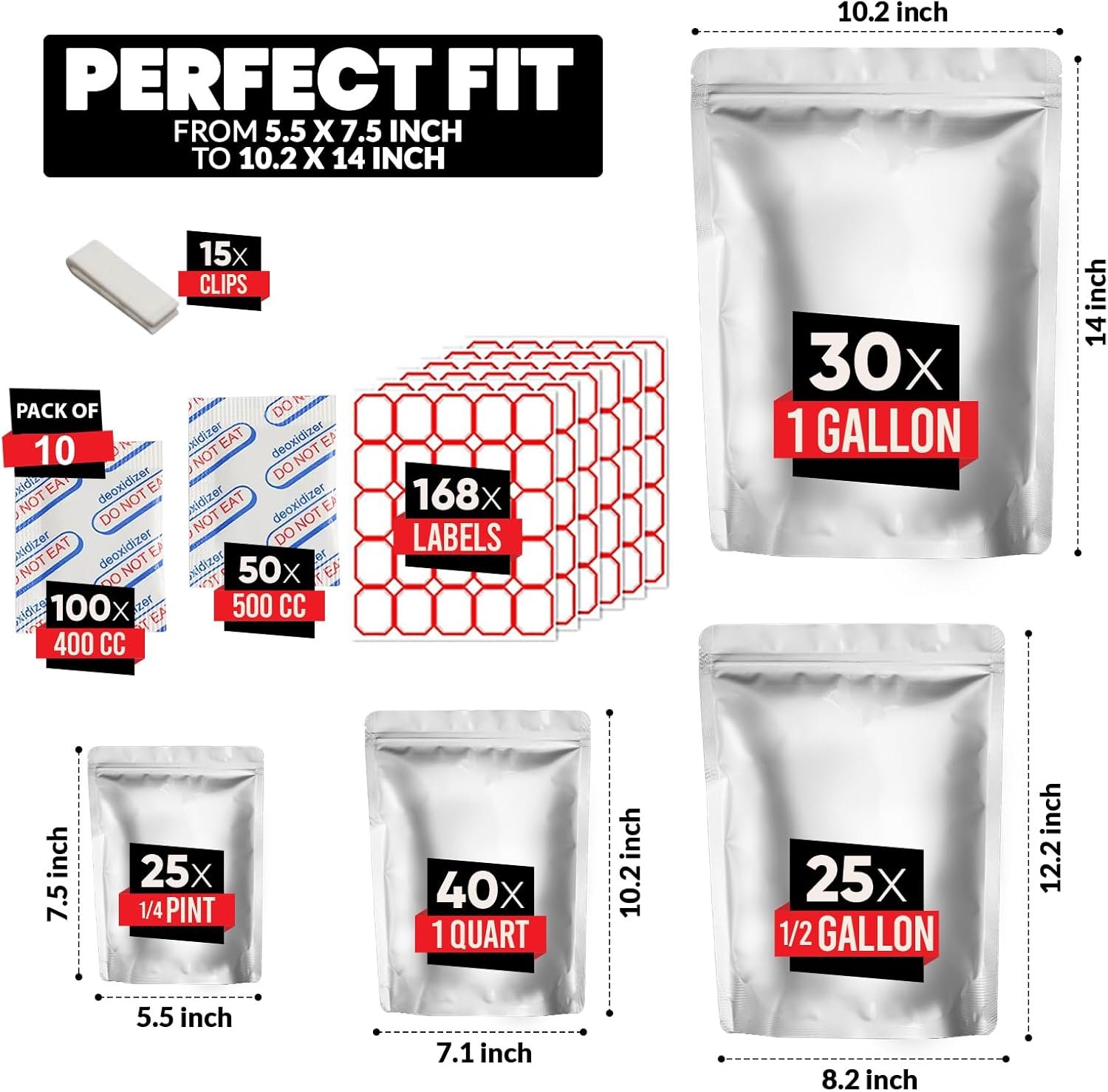
8.5/10 · DryFoodLab scoreManufacturer image of the exact 120-bag kit. The brand advertises up to 11 mil; the Amazon details list 8.5–10.5 mil by bag size.
The ROYLO GLOBE kit has the most absorber capacity: 100 absorbers of 400 cc plus 50 of 500 cc, for 120 bags. That leaves spares for doubling up in gallon bags of pasta or freeze-dried food.
The listing gives four sizes (10.2 × 14, 8.3 × 12.2, 7.1 × 10.2 and 5.5 × 7.5 in) and thickness by size: 10 mil for gallon, 10.5 for half gallon, 10 for quart and 8.5 for the smallest. It includes 168 labels and 15 clips. The catch is that the listing never states food-grade material, and it recommends a professional heat sealer over smaller ones.
Pros
- 150 absorbers: 100 × 400 cc and 50 × 500 cc
- 120 bags in four sizes, 168 labels and 15 clips
- 10-10.5 mil for most sizes
Cons
- No food-grade claim on the listing
- Recommends a professional-grade heat sealer
- Best for
- Light, airy foods that need more absorber per bag
- Skip it if
- Buyers who want an explicit food-grade claim
Specifications
| Type | Bags + absorbers |
|---|---|
| Bags | 120 |
| Absorbers | 150 |
| Max absorber (cc) | 500 |
| Absorbers by capacity | 100 × 400 cc + 50 × 500 cc |
| Max thickness (mil) | 10.5 |
| Thickness by size | 8.5–10.5 mil |
| Sizes | 26×36, 21×31, 18×26, 14×19 cm |
| Zip seal | Yes |
| Labels | Yes |
The ZRLEI pack is the simplest item here: 100 absorbers of 400 cc, split into 20 packs of 5. Small packs matter, because absorbers start working as soon as they meet air.
It is the natural partner for the SYMYNELEC kit, which is 45 absorbers short, and for bags sold alone, such as thick quart bags. It scores lowest in our method only because it has no bags to score. See our page on oxygen absorbers for other options.
Pros
- 100 absorbers of 400 cc
- Packed in 20 bags of 5, so you open few at a time
- Food-grade claim
Cons
- No bags: it is a refill only
- 400 cc may be short for a gallon of light food
- Best for
- Topping up any kit, or bags bought separately
- Skip it if
- Anyone starting from zero who needs bags too
Specifications
| Type | Oxygen absorbers |
|---|---|
| Absorbers | 100 |
| Absorber (cc) | 400 |
| Food grade | Yes |
How do I choose mylar bags and absorbers?
Choose by the food you store: sizes first, then thickness, then enough absorber capacity for each bag. Dense food like rice leaves little air; pasta, beans and freeze-dried food leave much more.
Use the 21% rule. Air is about 21% oxygen, so the absorber you need is roughly the air left in the bag in ml × 0.21, plus a margin. A common reference is 300-500 cc per gallon bag. Our oxygen absorber calculator does the math for any size, and how many oxygen absorbers do I need has a ready table. For the packing process, read long-term food storage step by step.
What are the most common buying mistakes?
The most dangerous mistake is using mylar and absorbers for food that is not fully dry. Here are six to avoid:
- Storing moist food. Mylar with absorbers is only for dry food, at about 10% moisture or less. Moist food without oxygen is a botulism risk.
- Counting bags, not absorbers. A 100-bag kit with 55 absorbers fills 55 bags. Check both numbers.
- Under-sizing absorbers for light food. A gallon of pasta or freeze-dried food leaves far more air than a gallon of rice.
- Opening every absorber at once. They start working as soon as their pack is opened. Use what you need within 15-30 minutes and reseal the rest.
- Trusting the zip. The zip is for after opening. Heat seal every bag for long-term storage.
- Comparing mil figures blindly. Some listings give total thickness, others per side, and most give the thickest size only.
Which one should I pick by cost level?
Cost level mostly follows how much is in the box, so decide what you need first. We do not list prices because they change daily; compare the cost per bag and per absorber on the current listing.
- Entry: ZRLEI 400 cc absorbers and the Home Sensei 30-bag kit. Pick ZRLEI if you already have bags, Home Sensei for a small run of thick gallon bags.
- Mid: Sukerle 100 kit and SYMYNELEC 100 kit. Sukerle for small portions with one absorber each, SYMYNELEC for the best mix of sizes.
- High: Leboduo 120 kit and ROYLO GLOBE 120 kit. These are the largest kits; ROYLO adds the most absorber capacity.
Want a narrower list? See mylar bag kits or thick mylar bags.
What is our verdict?
Frequently asked questions
What are the best mylar bags for long-term food storage?
For most homes, the SYMYNELEC 100-bag kit: 35 gallon, 45 quart and 20 half-pint bags, food grade, zip tops, labels and 400 cc absorbers. Its gallon bags are 11.8 mil thick according to the listing.
What size oxygen absorber do I need for a 1-gallon mylar bag?
A common reference is 300-500 cc per gallon bag. By the 21% rule, a gallon of rice leaves about 279 ml of oxygen, while pasta or beans leave about 479 ml, so light foods may need two absorbers.
Do mylar kits include enough oxygen absorbers?
Not always. The SYMYNELEC kit has 55 absorbers for 100 bags. The Leboduo, Sukerle and Home Sensei kits have one absorber per bag, and the ROYLO GLOBE kit has 150 for 120 bags.
Is thicker mylar always better?
Thicker bags resist punctures better, which matters for pasta, beans and handling. Bags of 5-7 mil or more are usual for long-term storage, and all five kits here list 8 mil or more at their thickest size.
Can I use a zip-top mylar bag without heat sealing it?
No. The zip is for convenience after opening. For long-term storage, heat seal the bag above the zip with a heat sealer or a clothes iron.
Based on official spec sheets, manuals and published owner feedback. We have not physically tested every model. How we review.