Cosori P101 Review: 10 Steel Trays, 16.2 ft² and 165 °F
- Data from official spec sheets
- Public scoring formula
- No paid placements
The Cosori P101 is a 10-tray stainless steel dehydrator with 16.2 ft² of drying area, 1,000 W, a rear fan and a 95-165 °F range. On paper it is the most capable all-rounder in our US catalog for big batches of jerky and fruit. The catch: it weighs 16.2 kg and the listing gives no noise figure.
On this page (7)
The Cosori P101 is a 10-tray stainless steel dehydrator with 16.2 ft² of drying area, a 1,000 W heater and a rear fan. On paper, it is the strongest all-rounder in our US catalog for people who dry in big batches. We have not run this unit ourselves: everything below comes from the official Amazon listing and our own math.
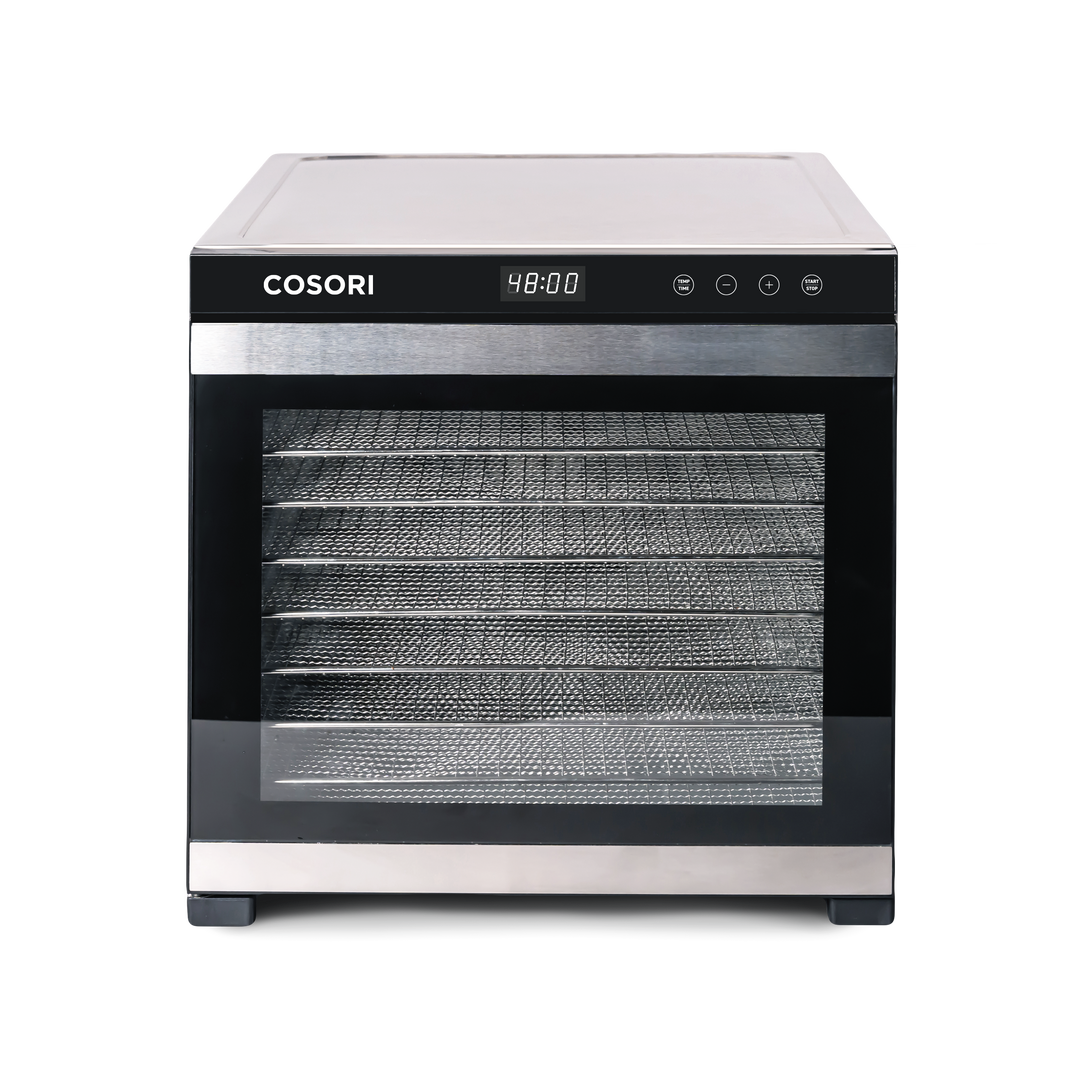
Cosori P101 10-Tray Stainless Steel
10 trays · 1,000 W · up to 74 °C
9.5/10 · DryFoodLab scoreThe P101 is built for volume. Ten stainless steel trays add up to 16.2 ft² of drying area, the most in our US dehydrator catalog. A rear-mounted fan pushes air horizontally across every tray, which is the layout that dries most evenly. The 1,000 W heater and a 95-165 °F range cover everything from delicate herbs to jerky, and the 48-hour timer handles slow, thick batches. Cosori backs it with a 2-year warranty. The trade-offs are size and missing data: it weighs 16.2 kg, and the listing states neither a noise level nor whether the trays go in the dishwasher. If you dry a few apples a month, it is more machine than you need.
Pros
- 10 stainless steel trays with 16.2 ft² of declared drying area
- Rear fan (horizontal airflow), so trays dry more evenly without rotating
- 95-165 °F range and a 48-hour timer cover herbs, fruit and jerky
Cons
- 16.2 kg (about 36 lb): a counter-top appliance you rarely move
- No noise figure and no dishwasher statement in the listing
- Best for
- Families and hunters who dry large batches of jerky, fruit and vegetables
- Skip it if
- Small kitchens, occasional users or anyone who needs to store it in a cupboard
Specifications
| Trays | 10 |
|---|---|
| Drying area (cm²) | 15,050 |
| Power (W) | 1,000 |
| Min temp (°C) | 35 |
| Max temp (°C) | 74 |
| Timer (h) | 48 |
| Trays | Stainless steel |
| Airflow | Horizontal |
| Weight (kg) | 16.2 |
| Warranty (years) | 2 |
| Trays | 10 |
|---|---|
| Drying area (cm²) | 15,050 |
| Power (W) | 1,000 |
| Min temp (°C) | 35 |
| Max temp (°C) | 74 |
| Timer (h) | 48 |
| Trays | Stainless steel |
| Airflow | Horizontal |
| Weight (kg) | 16.2 |
| Warranty (years) | 2 |
How much food fits in the Cosori P101?
About 1.6 ft² per tray, or 16.2 ft² in total, the largest declared area in our US catalog. The math is 15,050 cm² ÷ 10 trays = 1,505 cm² per tray.
For context, the Excalibur Performance 10-Tray declares 16 ft² and the LEM BigBite 10-Tray declares 10 ft². So the P101 and the Excalibur are in the same size class, while the LEM trays are about a third smaller.
In practice, capacity depends on how thick you slice and how close you lay pieces. Leave small gaps between slices so air can pass. A full load of thin apple rings or jerky strips on ten trays is a weekend of snacks for a family, not a single evening.
Is the temperature range right for jerky, fruit and herbs?
Yes: 95-165 °F (35-74 °C) covers all three. Herbs dry best at the low end, fruit in the middle and jerky at the top.
The USDA recommends keeping the dehydrator at 130-140 °F (54-60 °C) while jerky dries. It also asks you to heat meat to 160 °F (poultry to 165 °F) before drying. The P101 reaches 165 °F, so it holds the drying range with headroom. Our jerky guide walks through the full USDA method.
At the other end, 95 °F is low enough for basil, mint and other delicate leaves. The Excalibur Performance 10-Tray goes lower, to 85 °F, if you dry a lot of herbs.
Why does the rear fan matter?
A rear fan blows air across the trays (horizontal airflow), so every tray gets similar heat. In stacked round dehydrators with a fan at the top or bottom, air passes through the trays in series, and the trays nearest the fan dry first.
Horizontal airflow also tends to mix flavors less, since air does not travel up through each layer in turn. That matters if you dry onions and apples in the same batch. If you have struggled with trays drying at different speeds, see our uneven drying fixes.
How much power does it use in real life?
Up to 1 kWh per hour of drying, because it is rated at 1,000 W. That is the ceiling, not the average.
The formula is watts × hours ÷ 1,000. A 10-hour batch uses up to 1,000 × 10 ÷ 1,000 = 10 kWh. In practice the heater cycles off once the cabinet reaches temperature, so real consumption is lower, and it varies with room temperature and load.
To estimate your own bill, use our drying cost calculator with your local electricity rate.
Is it easy to clean?
The trays are stainless steel, which is easy to scrub and does not stain, but the listing does not confirm dishwasher use. Cosori describes food-grade stainless steel trays and a 48-hour timer, but no cleaning instructions.
Stainless trays tolerate hot water and a soft brush. For sticky fruit, line the trays with a silicone mat or parchment cut to size. That keeps juice off the mesh and makes cleanup much faster.
What does the listing leave out?
Three things: noise level, dishwasher compatibility and cabinet dimensions. None is a deal-breaker, but they matter in small homes.
- Noise: no dB figure. Every dehydrator runs a fan for hours, so check the manual if it will sit near a living area.
- Dishwasher: not stated for the trays.
- Weight: declared at 16.2 kg (about 36 lb). Plan a permanent spot for it.
What are the best alternatives?
The Excalibur Performance 10-Tray for a longer timer and warranty, and the LEM BigBite 10-Tray for a lighter, hotter unit.
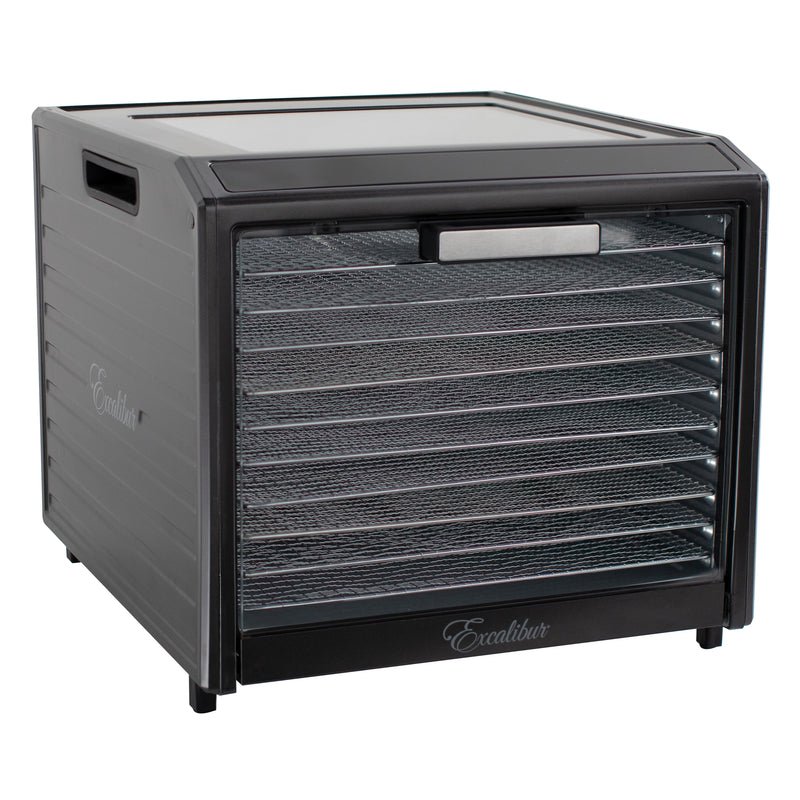
Excalibur Performance Series 10-Tray
10 trays · 800 W · up to 74 °C
9.5/10 · DryFoodLab scoreThe Excalibur Performance 10-Tray is the closest rival on paper. It declares 16 ft² of drying area on ten stainless steel trays, horizontal airflow and an 85-165 °F range. The 80-hour timer and 3-year warranty both beat the P101. It is also lighter, at 12.2 kg. The trade-off is power: 800 W for almost the same area. We compare them in detail in Cosori P101 vs Excalibur Performance.
Pros
- 16 ft² over 10 stainless steel trays
- 80-hour timer and a 3-year warranty
- Starts at 85 °F for herbs
Cons
- Lower power: 800 W for almost the same area
- No uses declared and no noise figure in the listing
- Best for
- Long, slow drying and delicate herbs
- Skip it if
- Buyers who want the fastest heat-up per square foot
Specifications
| Trays | 10 |
|---|---|
| Drying area (cm²) | 14,864 |
| Power (W) | 800 |
| Min temp (°C) | 29 |
| Max temp (°C) | 74 |
| Timer (h) | 80 |
| Trays | Stainless steel |
| Airflow | Horizontal |
| Weight (kg) | 12.2 |
| Warranty (years) | 3 |

LEM BigBite 10-Tray Stainless Steel
10 trays · 800 W · up to 80 °C
9.5/10 · DryFoodLab scoreThe LEM BigBite is built around jerky. It reaches 176 °F, has dishwasher-safe stainless steel trays and carries a 5-year warranty. At 8.8 kg it is much easier to move than the P101. The trade-off for that compact build is area: 10 ft² against 16.2 ft². The timer also stops at 24 hours. If most of what you dry is jerky, it is a strong, simpler option.
Pros
- Reaches 176 °F, the widest top end of the three
- Dishwasher-safe stainless steel trays
- 5-year warranty, the longest here
Cons
- 10 ft² of drying area, about 38% less than the P101
- 24-hour timer, half the P101’s
- Best for
- Jerky makers with less counter space
- Skip it if
- Large fruit harvests that need maximum tray area
Specifications
| Trays | 10 |
|---|---|
| Drying area (cm²) | 9,290 |
| Power (W) | 800 |
| Min temp (°C) | 35 |
| Max temp (°C) | 80 |
| Timer (h) | 24 |
| Trays | Stainless steel |
| Airflow | Horizontal |
| Dishwasher safe | Yes |
| Weight (kg) | 8.8 |
| Warranty (years) | 5 |
Frequently asked questions
Can the Cosori P101 make safe jerky?
Yes, on paper. It reaches 165 °F (74 °C), above the 130-140 °F the USDA recommends for the dehydrator during drying. You still need to heat the meat to 160 °F (poultry 165 °F) before drying.
How much drying space does the Cosori P101 have?
Cosori declares 16.2 ft² (15,050 cm²) across 10 trays. That is about 1.6 ft² per tray, the largest declared area in our US dehydrator catalog.
How much electricity does the Cosori P101 use?
At most 1 kWh per hour, since it is rated at 1,000 W. A 10-hour batch uses up to 10 kWh; the real figure is lower because the heater cycles on and off once it reaches temperature.
Are the Cosori P101 trays dishwasher safe?
The listing we reviewed does not say. It confirms the trays are stainless steel but does not state dishwasher compatibility, so plan on washing them by hand until you check the manual.
How heavy is the Cosori P101?
It weighs 16.2 kg, about 36 lb. That is heavier than the Excalibur Performance 10-Tray (12.2 kg) and the LEM BigBite 10-Tray (8.8 kg), so give it a permanent spot on the counter.
Based on official spec sheets, manuals and published owner feedback. We have not physically tested every model. How we review.